integrationsource-backed
jev-use for computer use
A Cua Driver integration that uses Jev to choose bounded computer actions on macOS, Windows and Linux.
ACTION SELECTION
Jev choosing the next click, key or app action from a bounded action space built out of the DOM, OCR or an accessibility tree.
Choose a project, read its requirements, then follow its setup reference or a related guide.
uv; Python 3.13+ fetched by uv; cloud browser or local Chrome
Let Jev choose a proposed next step, then apply an explicit allow, review or fallback policy before any tool runs.
Development previews and demos of Jev picking the next action in a browser or desktop loop.
A Cua Driver integration that uses Jev to choose bounded computer actions on macOS, Windows and Linux.
Speech becomes text, the DOM becomes an action catalog and Jev chooses the next click.
A Mac begins executing a selected action while the user is still speaking.
A calendar task compares a Jev-based action loop with built-in computer use.
A Marketplace plugin connects a Cline desktop app to Jev through Vercel AI Gateway.
Voice is mapped to bounded Figma actions, with Jev choosing the operation.
Many browser scenarios run in parallel with Jev serving as a low-cost evaluator.
A 706K-parameter form-filling specialist is compared with Jev on a narrow evaluation.
A computer-use agent that OCRs the screen, asks Jev to pick the next action, and clicks; the author says the loop generalizes across operating systems.
The accessibility tree becomes the state and possible actions become questions; Jev picks the next step in a Stagehand-driven browser.
A WXT browser extension that asks Jev whether page elements are clutter (ads, cookie banners, upsells), then saves reusable per-template hiding rules; sends snippets rather than full pages, bring your own key.
A browser extension that asks Jev, per post, whether it matches a plain-language filter and collapses the ones that do; framed by the author as a content firewall.
A browser agent where Jev picks the operation and target element from a numbered element table each step, and a small LLM is called only when text has to be typed.
A mobile agent that drives a real Android device through Mobilerun with Jev choosing actions; the README states the limits of the demo itself.
A preview of browser automation for OpenCode powered by Jev plus its browser-use CLI, framed around speed; the demo video sits in Neriousy's post and dax's root post.
Coverage of browser-use/jev-ultrafast: a numbered element table per step, Jev picks action and target, an LLM only for typed text, with the project's listed limitations.
A Chrome extension that labels posts in the X timeline with Jev across five dimensions while scrolling.
A browser extension (and web version) that classifies the news article you are reading by political framing, article type, topic and how loaded the language is, using Jev as a fast probabilistic classifier.
An open-source macOS pointer companion driven by Jev or Gemini Live: a local OmniParser build on CoreML reads the screen, Jev picks where the pointer goes, Ctrl+K takes a typed task. Bring your own keys.
A browser skill that takes a website and a task, opens the browser and lets Jev decide every click from what is on screen. Video demo; the code is shared inside the club's community rather than publicly.
Say it and the Mac does it: the loop reads the accessibility tree, asks Jev which element to act on, acts, repeats — deliberately naive, no screenshots, no vision model.
A Chrome extension that labels every post on X (Substance, Humor, Chit-chat, Promo, Junk, AI-written) plus an AI-probability score, and folds the ones you don't want.
Tell the extension what you are working on; Jev checks every open tab at the door in a single call and shows the freeloaders out.
A Chrome extension that uses Jev to estimate a page's purpose and the writer's position (ad, testimonial, explainer…) and colour-codes Google search results accordingly.
An open-source Codex skill: install it, set a Jev API key, and Codex drives desktop apps with Jev making the per-step calls — the author reports the biggest gains on tasks with frequent checks and tool calls.
A computer-use assistant driven entirely by decision models: sub-second latency, near-zero cost, and it decides what to type without calling an LLM.
A Rust runtime that lets any agent operate desktop apps through their real UI structure (OS accessibility trees) with stable element refs, from the author of the hook-based routing demo.
Browser automation split in two: an LLM plans the task, Jev makes the concrete in-page choices; shipped as a library, a CLI and an MCP server.
Desktop computer-use agent released as open source and slated to become part of the author's internal verification workflow.
An open-source Chrome extension (store review pending) that labels posts on X, Threads and Weibo with rules you define, powered by your own TypeSafe account.
Turns plain-language critical-path tests into bounded UI actions chosen by Jev. The runner checks a fresh screenshot after each action and records a step-by-step result.
Maps visible UI states to bounded action options so Jev can select the next browser step. The repository includes a food-ordering demonstration with action limits in code.
A macOS menu-bar voice controller with on-device speech recognition and Jev decisions for commands and UI actions.
A Windows companion that collects visible WeChat messages with local screenshots and OCR, then uses Jev to rank three draft replies for the user to send manually.
A Chrome extension scores Hacker News stories on five factors with Jev and reorders the page using adjustable weights.
A MoonBit Jev client and CLI with game, shell-risk and browser experiments and the author's measurement reports.
A Manifest V3 port of jev-ultrafast that lets Jev choose clicks, keystrokes and dropdown actions in the user's existing Chrome tab; a separate text model handles typed content.
A playable Three.js driving simulation where Jev selects sampled steering and speed paths from compact road, traffic and route state.
A local Node and Playwright app streams partial speech transcripts, asks Jev for intent and target choices, then applies code-level action gates.
Text and multimodal LoRA adapters on Qwen3.5-4B for closed-option GUI element and action decisions, published as a separate Cua-S1 model version.
A browser agent gives Jev a numbered page table and executes its chosen operation and row, using a text model when text entry is required.
A headless-browser agent uses Jev to select actions from real page elements and exposes the same navigation loop through MCP, CLI and a library.
An experimental browser harness for the original Civilization II that asks Jev to choose empire, city, research, diplomacy and unit actions. It records player-visible observations and model probabilities in a spectator display.
A local MCP server for Windows that combines UI Automation actions with checkpointed web-research jobs. Jev selects from a bounded desktop action list and can rerank stored evidence or check a claim against an exact passage.
A local TypeScript library and CLI where Jev chooses exploratory browser actions and assesses observed results. Playwright executes configured actions, exact assertions decide outcomes, and saved traces support replay.
A browser and macOS computer-use harness that checks completion claims against observed state and gates irreversible actions with Jev. Its dual mode also delegates mechanical steps to Jev while a driver handles broader decisions.
A TypeScript browser SDK combines native Playwright actions with Jev decisions over observed elements. Its CLI, MCP server and library share the same execution and verification core.
An MCP server uses Jev to drive Chrome through observed page elements, either in an existing browser through an extension or in a separate profile. Tasks expose progress, questions and extracted results to the host agent.
A Go controller uses Jev to select native macOS actions from Accessibility observations provided by a persistent Swift worker. Closed target tokens keep selected actions tied to the current app and window state.
A Chrome side panel discovers WebMCP tools exposed by the current page and uses Jev to predict a tool and its arguments from the user's input. Questions are derived from the tool schema, including choices, booleans and spans of the user's own words.
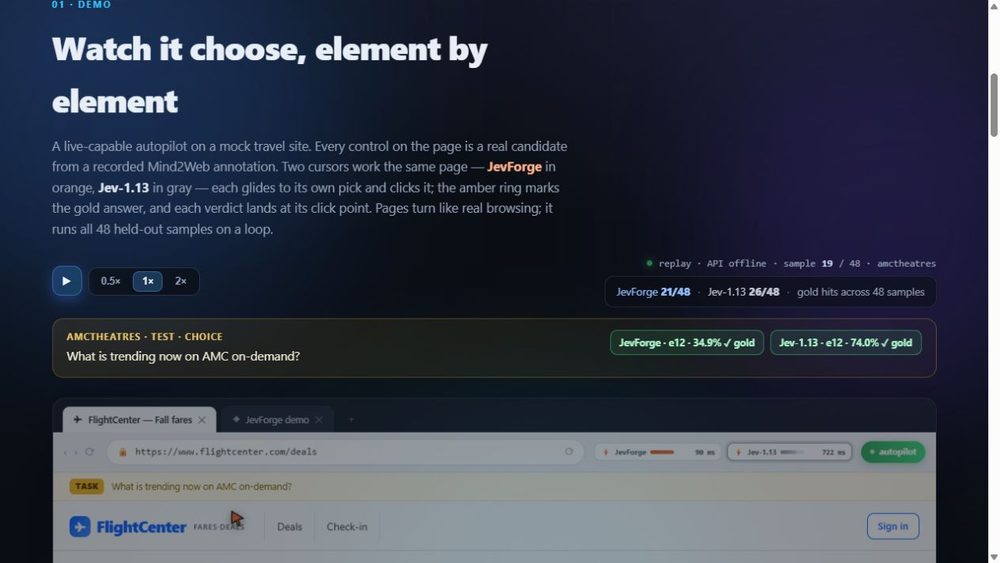
An end-to-end research toolkit builds decision records, trains and calibrates candidate scorers, and serves a Jev-compatible API. Its released Qwen3.5-0.8B model ranks supplied web actions, while the public demo presents recorded Mind2Web decisions.
A Python browser agent uses Jev decisions over observed page candidates and returns structured results or cited answers. Browser execution, spending controls and result verification are handled by separate code paths.
A TypeScript browser decision core chooses operations and observed targets from snapshots without importing a particular coding harness. CLI and harness adapters share the same Jev questions and step validation.
A bounded executor lets a parent agent hand browser work to Jev over agent-browser snapshots. The parent receives structured handoffs when the task is blocked, repeats or reaches its step budget.
A Mac voice interface combines local whisper.cpp transcription with Jev decisions over an enumerated action catalog. Code executes the selected shortcuts, app controls and multi-step actions, with an inspector for the decisions.
A native Mac switcher asks Jev which running app the user is likely to open next. A Rust core supplies recent activation and dwell-time history, while a Swift menu-bar app executes the selected app activation and exposes the request and response.
Surf provides optional semantic commands that ask Jev to choose from allowed browser actions and check progress toward a goal. The controller validates each selected action against the current page.