replicasource-backed
NanoJev
A 0.6B Qwen-based open implementation of parallel typed decisions, with training and evaluation code.
OPEN REPLICAS
Independent projects that reproduce the typed-decision interface on open weights or tiny specialists.
Choose a project, read its requirements, then follow its setup reference or a related guide.
A modern browser for the domain playground
Open models that speak the Jev interface locally, with their own accuracy and latency numbers.
A 0.6B Qwen-based open implementation of parallel typed decisions, with training and evaluation code.
An independent local probability-decision implementation inspired by Jev.
A local classifier-style model targets type-safe JSON workloads on Apple silicon.
A prototype removes text and JSON generation to return direct decisions on DGX Spark.
A 706K-parameter form-filling specialist is compared with Jev on a narrow evaluation.
A family of tiny Jev-like decision models — 0.5B at launch, now 0.6B, 4B and 8B on Qwen3.5 — using the same LoRA-plus-pointer-head recipe with block-causal masking so questions run in parallel; the HTTP API mirrors System One, so the official SDK works with only a base_url change.
A server that implements the TypeSafe/Jev HTTP API on Qwen3.6-35B-A3B with SGLang: prefill-only, one extra token per question, radix caching, deployable on Modal.
SimpleJev.ai from Featherless: a fully open-source library that takes any Hugging Face model and 'Jev-ifies' it behind an API endpoint, with public no-key endpoints, vision via chat-format images (Gemma, Qwen) and an RFDT tuning recipe to distil your prompts into a smaller production model.
An open replica trained on 92 public datasets plus synthetic generators, on Gemma 4 E2B (LoRA) and Gemma 3 270M, served via FastAPI on Modal with a live demo.
Constrains token selection to choice indices so any open LLM answers many questions in one pass; includes Doom and Wikipedia-racing demos on Qwen models.
A drop-in replacement for the TypeSafe client that answers the same state-plus-questions contract with an ordinary LLM API, useful for comparing Jev against OpenAI- or Anthropic-compatible models on identical calls.
An early independent implementation of a Jev-style interface on an open model; cited as inspiration by daseinlabs/open-jev.
Reimplements a System One decision model on Gemma 3 270M with a LoRA of 2.6M trainable parameters, scoring all options in one forward pass; trains in a free Colab and ships weights in the repo.
One-pass option scoring with a local Gemma 3 4B via MLX: pre-written options are batched against a cached context; implements the System One API contract and includes a Doom terminal demo.
Prefill once, broadcast the KV cache per field, evaluate all fields in one pass on Qwen 1.5B–8B models; a Hugging Face Space demo exists.
State plus typed questions in, calibrated probabilities out, built on Qwen3.5-4B, with a 650 MB WebGPU browser build on Qwen3.5-0.8B.
Uses an open diffusion language model for structured JSON judgments without fine-tuning and benchmarks against Jev's public eval cases.
An open-sourced decoding engine for autoregressive LLMs inspired by Jev: one output token per decision, no out-of-schema outputs, KV-cache reuse; demoed on SGLang with Qwen 27B.
Rebuilt TypeSafe's output format with Qwen 3.8 27B on Cerebras via an LLM gateway and compared the two.
An open typed-decision model on DeBERTa-v3-large answering Choice (up to 255 options), Score and yes/no questions from one forward pass, trained on 18K states and 42K questions.
A drop-in for TypeSafe's API powered by a 400M GLiFormer model; point the official SDK's base URL at it. Deploys on Modal or CPU via ONNX Runtime and ships a bench folder.
`pip install von`: a non-autoregressive local decision model claiming wire-protocol compatibility with Jev (`von serve`), with ModernBERT or Laya-421M backends; Apache-2.0.
A TypeSafe-compatible adapter running LFM2.5-1.2B through llama.cpp (about 1.25 GB download) with CUDA, ROCm and Metal builds.
The author trained an MLP head on top of Qwen 4B and published it on Hugging Face as an open-weights Jev-like model, with a demo video.
The browser-based Jev-like demo openjev.com reached the front page (628 points, 265 comments at fetch). The site now labels itself SemIf, "formerly OpenJev", running Qwen3 0.6B, MiniCPM5 2B and Qwen3.5 4B locally via WebGPU.
Bespoke Labs' open take on a Jev-like model: local typed decisions plus a contrastive data-curation recipe and evaluation code, released as data, weights and training recipe together.
GitHub Next's 'poor man's Jev': a Jev-compatible local API built in a morning on top of DiffusionGemma (swappable via config), so team members without Jev access can run the same call shapes locally.
An mmBERT-based 0.3B typed decision model published a year before Jev and rediscovered during launch week; weights and a demo Space on Hugging Face, plus a multilingual variant. Ports to MLX and Core ML followed within days.
Native MLX and Core ML runtimes for Laya typed decisions: `pip install 'laya-mlx[demo]'`, no text generation, no PyTorch, no cloud API. A Rubik's-cube demo runs 100 moves locally.
A non-autoregressive decision engine on ModernBERT (151M) with calibrated uncertainty, an audit of the Jev benchmark, and an in-browser WebGPU playground; Apache-2.0 with PyTorch and ONNX weights on Hugging Face.
An open reproduction that answers noul/choice/score in one non-autoregressive pass with calibrated confidence, at 150M parameters — a non-LLM route to the same interface.
An open, Jev-compatible System One decision server running DiffusionGemma — one of several projects named openjev.
A container recipe for structured decisions with DiffusionGemma in NVFP4 on an NVIDIA DGX Spark, offered as the 'or just use this' route to a local Jev-like.
Five days after launch: a Thai + English System One model on Qwen3.5-0.8B with a 256-way slot head, Apache-2.0, sized to run on a laptop.
A Jev-style decision model built on IBM Granite 4.1 3B with an RHCD training recipe — 'when's IBM or Red Hat going to build their own Jev? I got it for them.'
An attempt at a Jev-like model built on Qwen 4B, published on Hugging Face and runnable locally.
Japanese-language decision weights on a 310M ModernBERT, published 'just in case' to Hugging Face.
A llama.cpp fork with a `jev` branch and docs/jev.md that runs Jev-style typed decisions on local models; the author's size-by-size picks are Qwen3.8-27B, Gemma 4 12B, Qwen3.5-4B and two tuned 'jwenv' Qwen3 PoCs.
A vLLM pull request adding a Jev-like structured-decision path on Gemma, cited by testers comparing open alternatives on the Pareto frontier with reflex and DiffusionGemma.
A System One style layer that returns typed, calibrated decisions from any open-weights LLM in a single forward pass (Hugging Face and vLLM), with benchmarks against Jev in the README.
A hosted, fully open-source and auditable classifier the author says now outperforms Jev and is free; image support and new models promised. 480k views on the launch post.
Turns any off-the-shelf LLM into a Jev-like decision layer and serves the same /v1/systemone API locally — no API key needed.
Jev-style parallel constrained decisions for any MLX model on Apple Silicon: typed, schema-valid JSON in one forward pass.
LoRA fine-tuning experiments for Jev-like typed judgments on Qwen3.5-0.8B, published with datasets, adapters, evaluations and a full write-up of why it was abandoned.
Adapts first-token logprobs from any OpenAI-compatible endpoint (cloud or local) into bounded Jev-style choices and scores; text, image or audio in when the backend exposes logprobs. Node + Python, with agent skills and a 2048 demo.
A llama.cpp fork serving Jev-like models as an inference server.
Answers image questions with option probabilities and bounding boxes; trained on CUB-200-2011 with a Qwen2.5-VL backbone.
An independent 0.8B Qwen3.5 model for typed decisions, published with weights and a comparison against Jev.
An independent decision model with published code and model heads, served through a System One-compatible API.
A Python library that turns open causal models into Choice, Noul and Score decisions with access to logits or hidden states.
Text and multimodal LoRA adapters on Qwen3.5-4B for closed-option GUI element and action decisions, published as a separate Cua-S1 model version.
A Rust engine derives typed System One judgments from model log probabilities and exposes them through CLI, MCP and a Jev-compatible HTTP server.
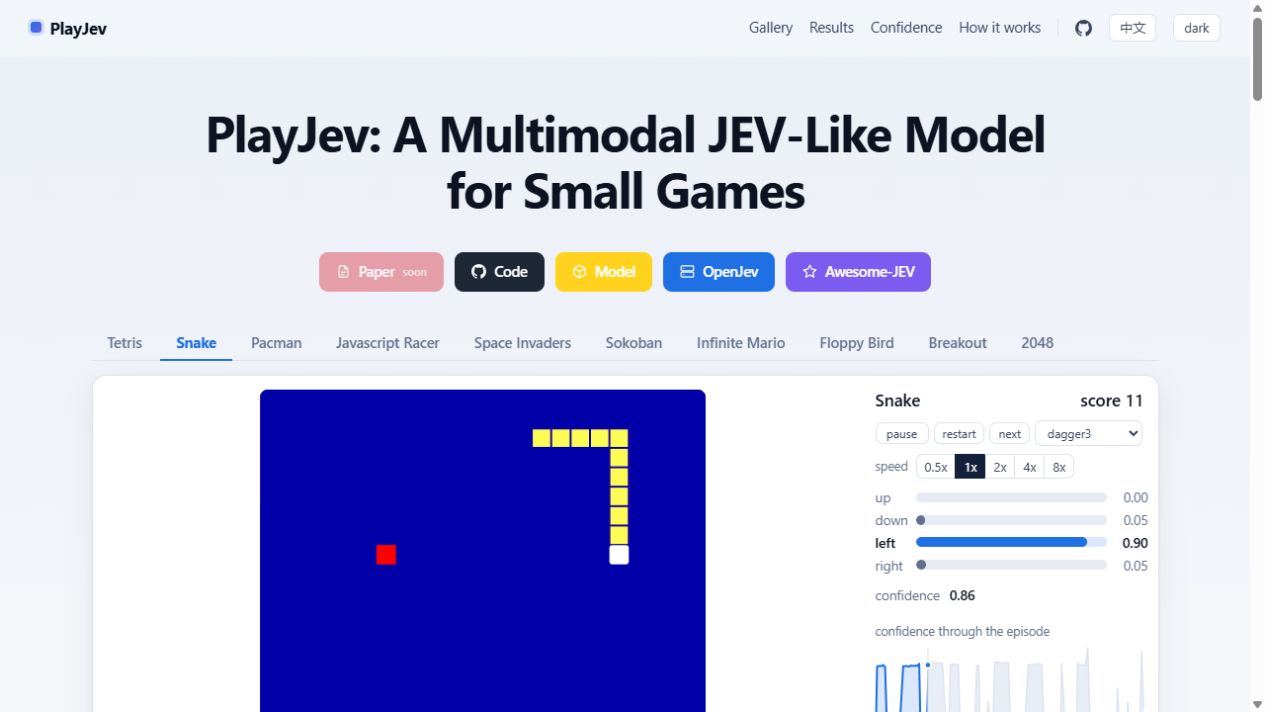
An independent Jev-like model fine-tuned from Qwen3.5-0.8B-Base to choose legal actions from raw game frames. The project publishes model weights, training records and a gallery of ten browser games.
An independent Jev-inspired model and serving project for Apple Silicon. Fine-tuned open backbones return Choice, Score and Noul probabilities through a Jev-shaped API, with calibration artifacts and worked use cases.
A local daemon and CLI for downloading and running open decision models behind a TypeSafe-compatible API. It includes an MCP interface and model definitions for typed Choice, Score and Noul workflows.
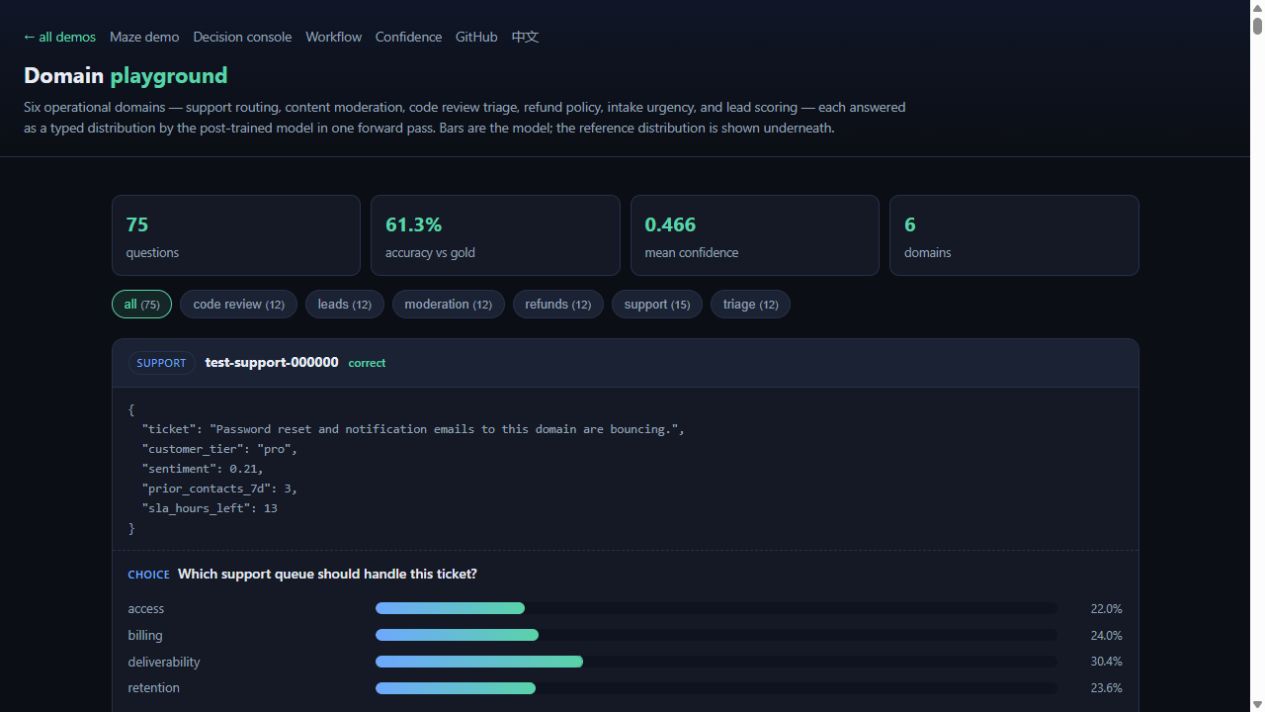
An independent Jev-style project that freezes a language-model backbone and trains a small decision head over cached candidate features. It publishes typed probability outputs, datasets and browser presentations of its benchmark and game policies.
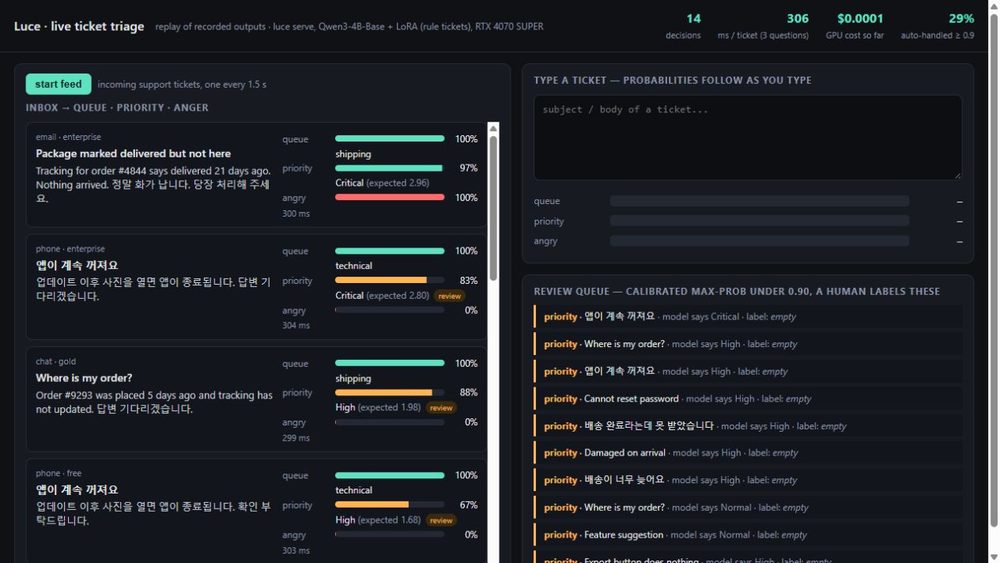
A task-specific pipeline generates or labels data with an LLM teacher, trains a LoRA and decision head, then evaluates and serves Choice, Score and Noul probabilities. A public support-triage replay shows saved model outputs and review routing.
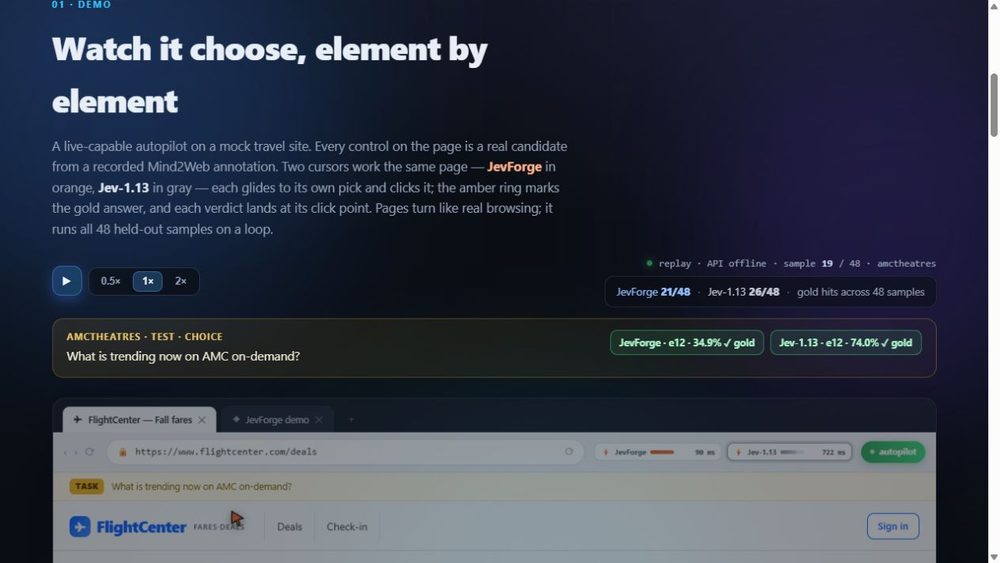
An end-to-end research toolkit builds decision records, trains and calibrates candidate scorers, and serves a Jev-compatible API. Its released Qwen3.5-0.8B model ranks supplied web actions, while the public demo presents recorded Mind2Web decisions.
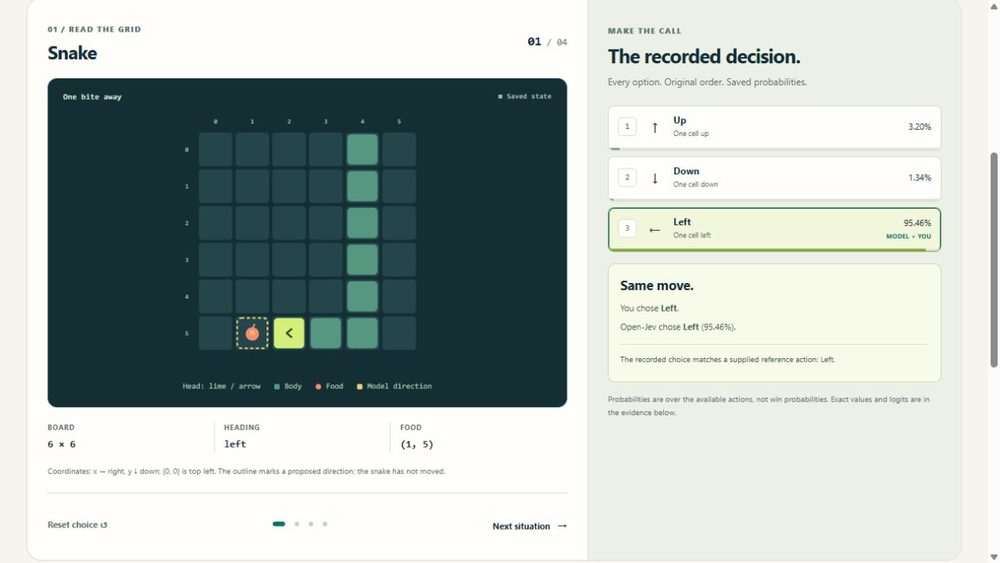
An independent family of LoRA adapters and scalar decision heads returns Choice, Noul and Score outputs over pinned Qwen backbones. The project publishes training data, evaluation records, a CPU classification workbench and interactive saved-decision replays.
A Qwen3.5-4B LoRA adapter answers multiple typed questions without generating answer tokens. Its runtime combines label-token readout with a learned candidate head, option-order averaging and saved calibration profiles.
A local semantic engine answers typed questions about application state and documents using an NLI model. It adds evidence retrieval and a Relation primitive alongside a Python API and TypeSafe-compatible HTTP server.
A local NLI backend scores caller-defined Choice, Score and Noul questions, with temperature scaling and low-confidence abstention. Python, CLI and MCP interfaces expose the same decision layer.
A native CPU server serves an independent decision model through the TypeSafe wire format. Yes/no predictions are also composed into option distributions and ordered scores, with shared-state reuse and packaged OpenVINO or GGUF weights.
Distilled Qwen models answer Choice, Noul and Score questions by reading option-token logits. The project releases 4B and 9B weights, fitted temperatures, a TypeSafe-compatible server and runtimes for CUDA or GGUF.
A training and deployment library adapts language-model backbones to typed decisions with learned pointer heads or direct option-token readouts. It publishes LoRA checkpoints, data preparation, calibration and evaluation tools alongside an archived application replay gallery.
A family of open 4B and 27B models applies stated rules and policies through typed option probabilities. The repository includes data generation, distillation, quantization, evaluation and a TypeSafe-compatible server, with GPU and Apple Silicon builds.
A deployment toolkit exports compatible open decision scorers to ONNX, quantizes them and serves the TypeSafe request format locally. It preserves upstream readouts and calibration settings while exposing accuracy and precision trade-offs for CPU deployment.
An evaluation library expresses agent, quality and security checks as typed questions and packs compatible checks into shared decision requests. The same definitions can measure recorded traces or gate an agent step, using hosted Jev or supported local decision engines.
A Swift package offers typed probabilities, enum choices and ordinal scores through a model-and-session interface. It can call TypeSafe Jev or a compatible local server, and an optional MLX backend reads local model token probabilities without generating text.
A Rust inference server exposes open decision models through the TypeSafe-compatible API. Candle inference, dynamic token-based batching and CPU, Metal or CUDA builds support serving Laya through the same typed request contract.
An independent CUDA runtime scores verified single-token option labels with existing language-model weights. It batches independent fields through vLLM, reuses shared prefixes when supported and assembles typed output in code; browser experiments also use local WebGPU models.
A local workbench runs open decision engines side by side and can compare them with hosted Jev. It includes a visual request builder, dataset benchmarks, truncation diagnostics and resource or concurrency measurements with separate engine processes.
A Qwen3-0.6B backbone with its language-model head removed scores caller-supplied candidates through a permutation-equivariant head. The project releases training, serving and prefix-sharing code for Boolean, Choice and Score decisions, including a coding-completion checkpoint.
An independent model inspired by Jev evaluates text, images and video against supplied candidate decisions. A Qwen backbone and decision head produce candidate probabilities without generating answer text.