demoauthor demo
Subway Surfers at parallel scale
Jev chooses game actions and is shown across many concurrent runs.
FAST LOOPS ON STRUCTURED STATE
Real-time loops where the model picks an action many times a second from a small, fixed set.
Choose a project, read its requirements, then follow its setup reference or a related guide.
A modern browser for recorded playback
Structured game state in, action out: Doom, Mario, chess, racing, drones and driving sims.
Jev chooses game actions and is shown across many concurrent runs.
A 0.6B Qwen-based open implementation of parallel typed decisions, with training and evaluation code.
A thread connects browser, database, email, QA, drawing, games and low-level GPU experiments.
Jev picks NES controller inputs from object-centric JSON telemetry rather than screenshots, choosing among seven legal actions and logging latency and probabilities per decision.
A layered controller: classical vision at 15 Hz, a 50 Hz reflex safety layer, and Jev at about 2.5 Hz choosing tactical maneuvers from JSON scene descriptions.
A driving simulator where Jev picks the next control action; the author frames it as rebuilding self-driving in under an hour.
A router where Jev decides which LLM should serve each incoming request; the same author hosts a Pac-Man page where Jev chooses a direction at every junction.
Constrains token selection to choice indices so any open LLM answers many questions in one pass; includes Doom and Wikipedia-racing demos on Qwen models.
A Doom agent with separate Jev channels for navigation (5 decisions per second) and combat (12 per second).
3D chess where the same model plays both sides; the viewer can watch or take over one side.
Brood War compiled to WASM and exposed as an MCP server with Jev playing; the author jokes it still loses to a Zerg rush.
A text MMORPG maps player intent to typed server actions with Jev, replacing a slower LLM step.
A narrative game where each villager decides tick by tick how to treat the player, with a view that shows what Jev read and answered; 21 tracked outcomes and per-interaction cost counters.
A 3D robot companion driven by one TypeSafe call per turn answering nine typed questions at once, with confidence gating to act, ask or do nothing; no text generation.
Adapts the RuneBench RuneScape agent benchmark to Jev with about fifty bounded actions, a tick-mode controller and a live dashboard.
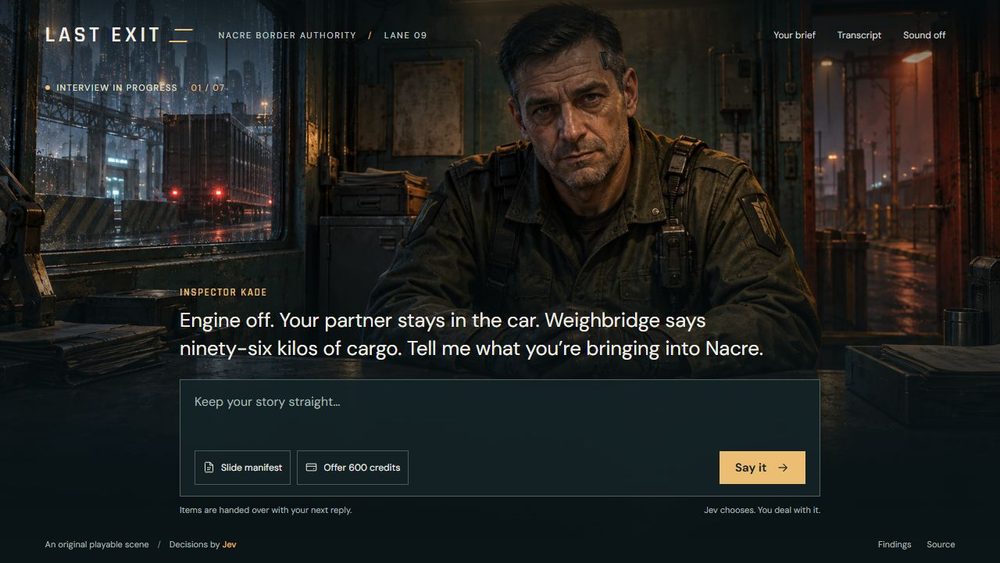
A text game where you talk your way past a border inspector whose actions are chosen by Jev from your typed replies; dialogue and consequences are authored game code, Jev only decides.
Scramble a Rubik's cube and watch Jev judge and solve it live, with difficulty tiers, XP and token-metered runs; labelled experimental and fan-made.
Tic-tac-toe and Connect Four against Jev, where the model picks the move and the code keeps the rules.
A small game where you race Jev at classifying a message as spam, built to show its latency.
Jev hooked to a racing game through a Python API and a display UI; the author describes a trick of buying thinking time and notes the course is fixed.
A self-driving simulation built to test Jev: structured sensor state in, typed decisions out (steer, brake, overtake, pedestrians, speed limits); the prompt is published.
Turns Jev into a pixel-art generator by asking 256 multiple-choice questions, one per pixel, plus refinement passes.
A Minecraft agent that plans with Astra and lets Jev control step-by-step actions, with native recording, tested routes and run verification; the Jev decision rules live in models.mjs.
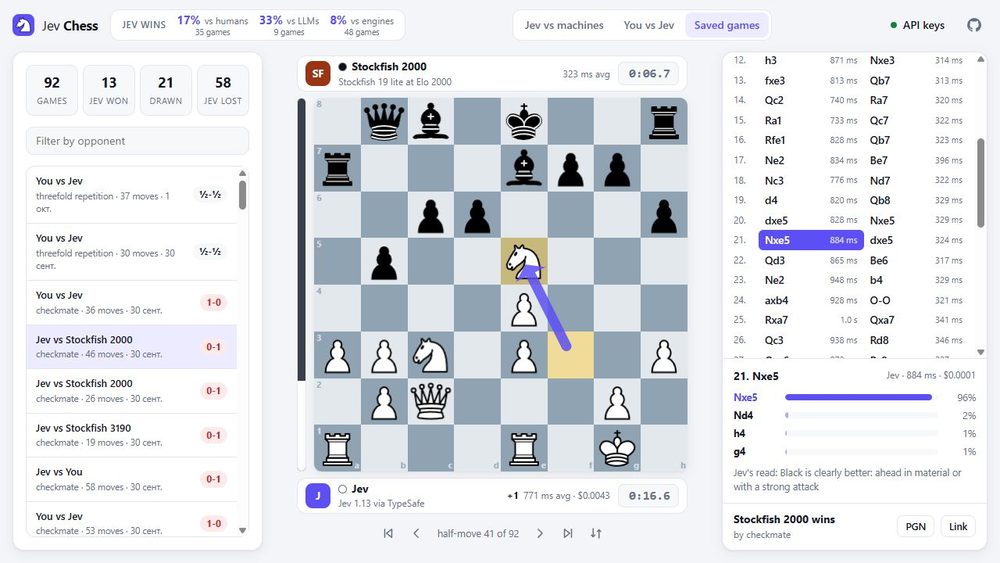
A one-page web app where Jev plays chess against any OpenRouter LLM, Stockfish, or a human, showing live moves, Jev's move probabilities, saved games and win rates.
Not Jev but Jev-shaped: a small decision model trained specifically for chess moves, built in the launch-week spirit.
A browser 1v1 quickscope arena built with Three.js where Jev plays the opponent's decisions in real time.
Doom played by the Laya System-1 model via ViZDoom: one forward pass per decision, fully local, live model probabilities on screen; the model advises, deterministic rails enforce.
The harness behind minelog.xyz: GPT-6 Astra plans, Jev makes the moment-to-moment decisions for a single Minecraft agent.
An interactive 3D Rubik's cube: turn it by hand, Jev watches each move, stays quiet while you progress, warns on a break and steps in with the next algorithm.
Jev-inspired sim with a local 2B model driving a PiPER robot in MuJoCo: the cube is relocated three times per run and the robot detects, interrupts and recovers.
A browser tic-tac-toe game where Jev chooses the O move from the currently free cells.
Two voice-controlled Godot games use local speech recognition for clear commands and Jev with game state for ambiguous ones.
A MoonBit Jev client and CLI with game, shell-risk and browser experiments and the author's measurement reports.
A playable Three.js driving simulation where Jev selects sampled steering and speed paths from compact road, traffic and route state.
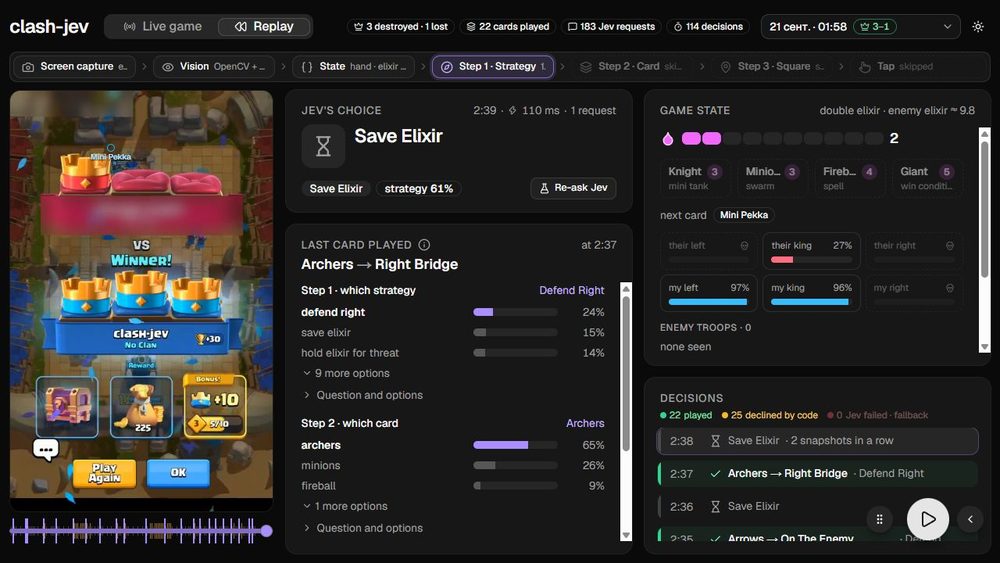
A Clash Royale experiment on an Android device that converts screen video into structured game state. Jev selects a strategy, card and placement, while the replay viewer exposes the questions and option probabilities.
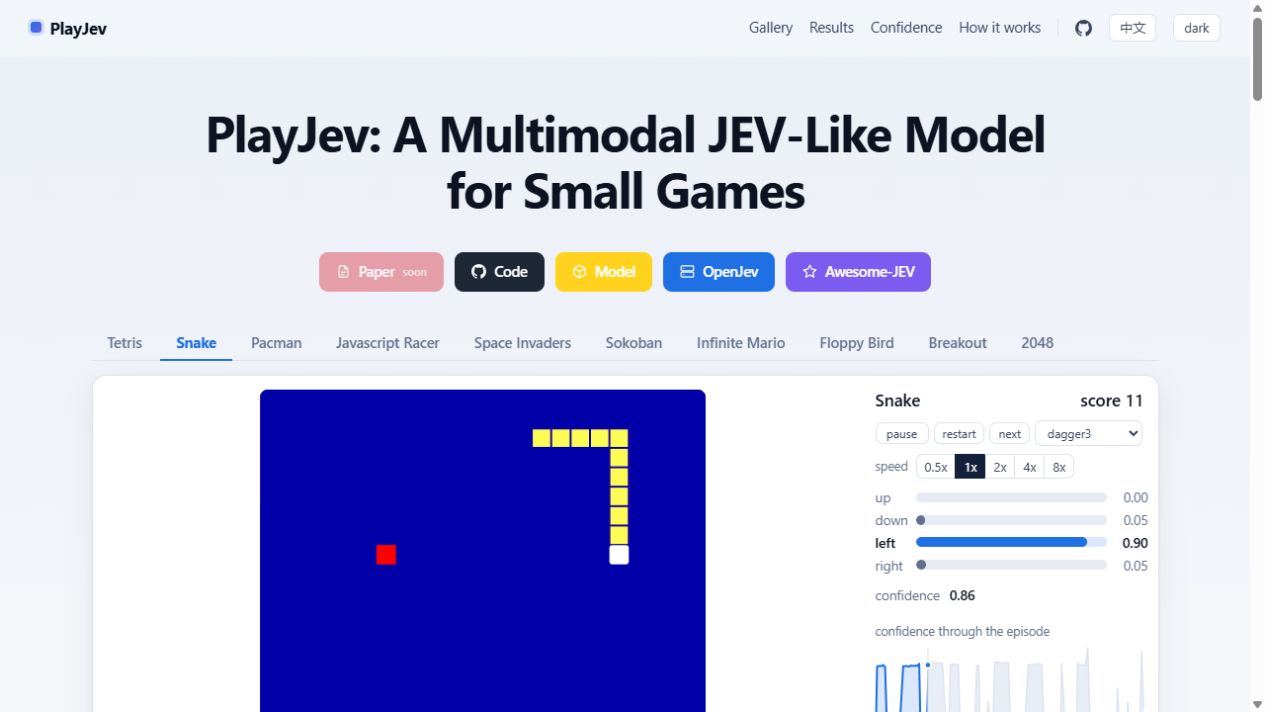
An independent Jev-like model fine-tuned from Qwen3.5-0.8B-Base to choose legal actions from raw game frames. The project publishes model weights, training records and a gallery of ten browser games.
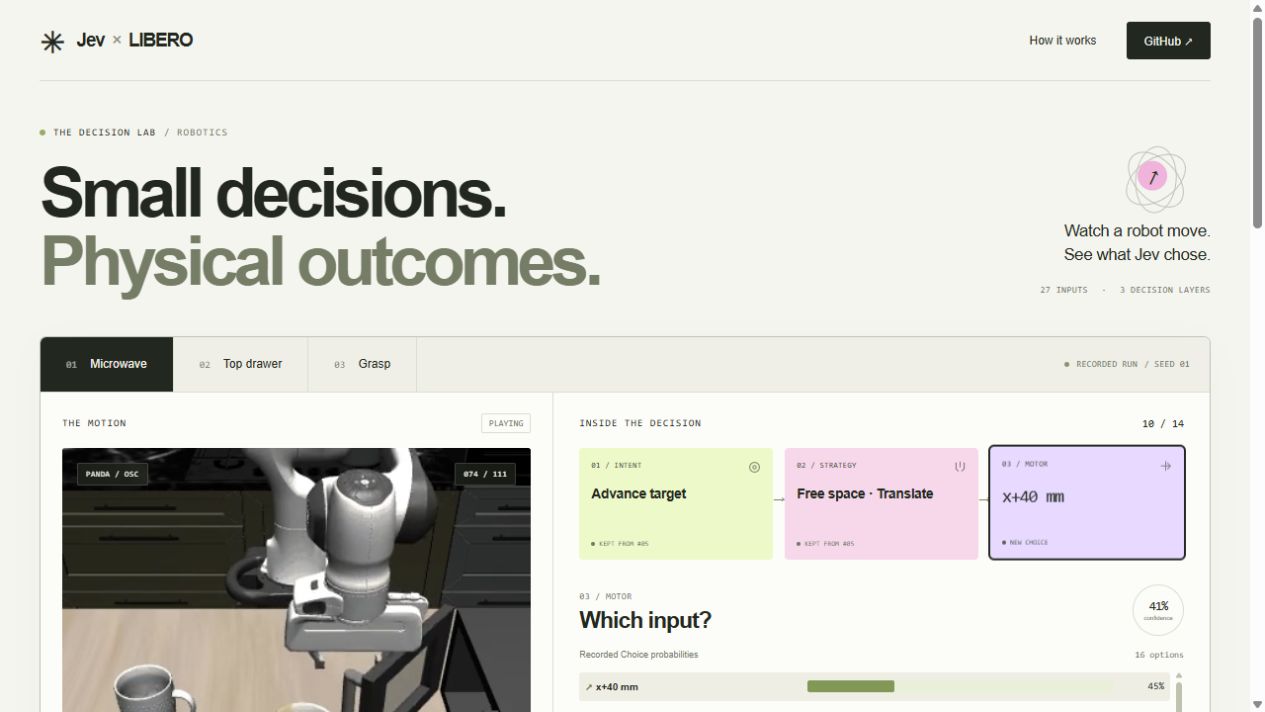
A configurable LIBERO robot-control experiment that combines Jev decisions with reversible physics previews. An interactive replay follows intent, motion family and control choices alongside saved trajectories.
A harness for the original StarCraft shareware campaign that gives Jev structured visible game state and executes its choices through keyboard and mouse inputs. The release includes a probability-overlay video and an inspectable run bundle.
An experimental browser harness for the original Civilization II that asks Jev to choose empire, city, research, diplomacy and unit actions. It records player-visible observations and model probabilities in a spectator display.
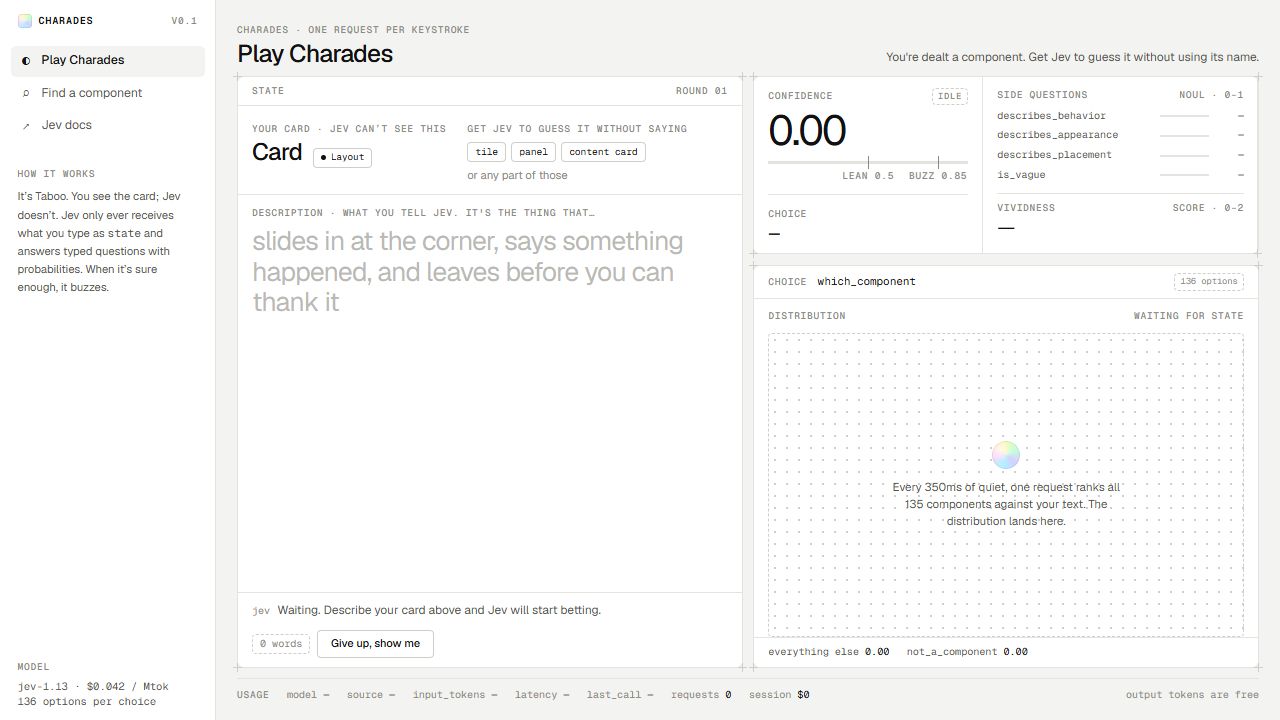
A Taboo-style game where a player describes a UI component without its forbidden words and Jev ranks the component library. A second mode finds a component from the job the player needs it to perform.
A React and Three.js arena shooter built around coffee deliveries and Jev-selected NPC tactics. Deterministic TypeScript owns the simulation, while recorded decisions can be replayed without model calls.
A TypeScript workspace containing Hundred, a town of 100 NPCs, and Jev Shogi, a human-versus-model board game. Each Jev request carries compact state and engine-legal next actions.
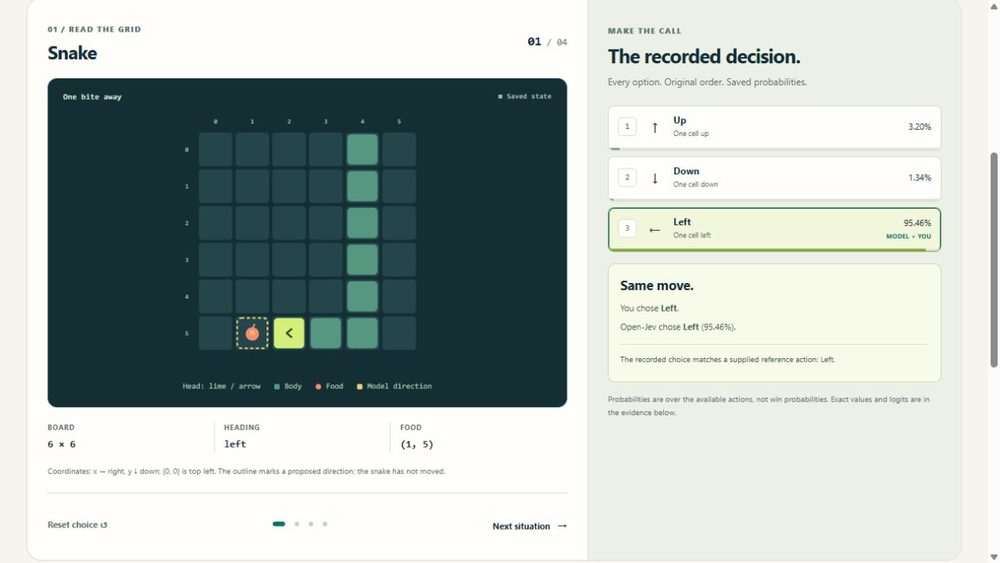
An independent family of LoRA adapters and scalar decision heads returns Choice, Noul and Score outputs over pinned Qwen backbones. The project publishes training data, evaluation records, a CPU classification workbench and interactive saved-decision replays.
A 3D football match in which Jev selects each player's intent from locally generated candidates. Geometry, physics and reflexes stay in code; a tactics board and JSON inspector expose the options, probabilities, chosen actions and fallback policy.
A museum stealth game where Jev estimates threat, suspicion, tactical intent and attention from each guard's observations. A server owns the world, checks every proposed action and records the complete decision trace for inspection.
A Terraria tModLoader mod with a Jev combat layer. Typed judgments select movement intent, danger and dash, grapple or jump decisions while deterministic controls handle aiming, available movement tools, timing and expired-intent fallback.
A Three.js drone simulator that uses Jev through the Vercel AI SDK provider. Code calculates flight telemetry and describes the situation; one model request chooses the four stick axes and whether to commit to landing or stop the motors.
A deterministic restaurant simulator that replays the same seeded dinner under rule-based, camera-assisted and Jev-planned service. Servers choose from feasible task tours, and the app logs the observations, candidates, confidence, latency and resulting service metrics.
A bilingual puzzle application where Jev classifies player questions and judges proposed explanations through typed outputs. It includes hints, private puzzle authoring, revocable share links and configurable TypeSafe, OpenRouter or Vercel AI Gateway access.
A music playground in which Jev selects closed plan labels such as form, key, tempo, register, accompaniment and harmony phrases. Deterministic code expands the plan into notes, engraves the score, plays audio and exports MIDI.
A small archipelago flight simulation that asks Jev about diversion, emergency broadcasts, traffic response and approach clearance. A tower decision orders waiting aircraft, while ordinary code enforces runway occupancy and the monitor exposes API exchanges and usage.
An independent CUDA runtime scores verified single-token option labels with existing language-model weights. It batches independent fields through vLLM, reuses shared prefixes when supported and assembles typed output in code; browser experiments also use local WebGPU models.
A MuJoCo robot workbench compares bounded skills, incremental movement and hierarchical control on manipulation tasks. It exposes decision traces, physical checks and alternative providers, including Jev, compatible chat models and a local MiniCPM model.
A Franka Panda simulator separates Jev's choice of manipulation intent from its choice of movement and gripper commands. A local executor applies those commands, and independent physical checks determine whether a task succeeded.
A browser simulation lets Jev choose bounded flight actions while local code maintains the world, sensors and movement projections. Optional slower planning advice can be requested asynchronously without replacing the reflex loop.
A local racing game asks Jev to choose the racing line, pedal input and whether the car is in trouble. Browser physics follows the chosen line, while recorded corner performance informs bounded speed adjustments for the next lap.
A local laboratory routes Doom observations and control commands through F prime flight software, CCSDS, Yamcs and Open MCT. Jev selects bounded game actions on the ground, with alternative rule and compatible-model providers for comparison.
A ManiSkill Franka simulator turns a spoken or typed English goal into a chain of hardcoded robot primitives. Jev chooses the next primitive and target, while local PD control executes the motion.
A 3D rover sandbox compares a local baseline with a Jev controller under energy, storm and sample-delivery constraints. A decision timeline exposes observations, available actions, model choices, execution and recorded usage.
A browser-native experiment compares Jev control with a labelled local policy using isolated Chocolate Doom WebAssembly engines. Jev chooses movement, view, firing and interaction controls from structured spatial state, and local code executes those controls.