A small archipelago flight simulation that asks Jev about diversion, emergency broadcasts, traffic response and approach clearance. A tower decision orders waiting aircraft, while ordinary code enforces runway occupancy and the monitor exposes API exchanges and usage.
A music playground in which Jev selects closed plan labels such as form, key, tempo, register, accompaniment and harmony phrases. Deterministic code expands the plan into notes, engraves the score, plays audio and exports MIDI.
A bilingual puzzle application where Jev classifies player questions and judges proposed explanations through typed outputs. It includes hints, private puzzle authoring, revocable share links and configurable TypeSafe, OpenRouter or Vercel AI Gateway access.
A deterministic restaurant simulator that replays the same seeded dinner under rule-based, camera-assisted and Jev-planned service. Servers choose from feasible task tours, and the app logs the observations, candidates, confidence, latency and resulting service metrics.
A Three.js drone simulator that uses Jev through the Vercel AI SDK provider. Code calculates flight telemetry and describes the situation; one model request chooses the four stick axes and whether to commit to landing or stop the motors.
A Terraria tModLoader mod with a Jev combat layer. Typed judgments select movement intent, danger and dash, grapple or jump decisions while deterministic controls handle aiming, available movement tools, timing and expired-intent fallback.
A museum stealth game where Jev estimates threat, suspicion, tactical intent and attention from each guard's observations. A server owns the world, checks every proposed action and records the complete decision trace for inspection.
A 3D football match in which Jev selects each player's intent from locally generated candidates. Geometry, physics and reflexes stay in code; a tactics board and JSON inspector expose the options, probabilities, chosen actions and fallback policy.
A preregistered audit compares English and Spanish state and instruction combinations for Jev on paired human-labelled datasets. The repository publishes the runner, frozen prompts, response-derived results and a CLI for repeating the protocol on other labelled data.
A CLI evaluates Jev against labelled application data, chooses per-question thresholds on one split and checks them on held-out examples. It writes a threshold lock and report, supports low-confidence fallback, and fails CI when accepted accuracy or coverage drifts.
A benchmark compares Jev and other typed decision systems using frozen tasks, explicit adapters and published result artifacts. Its score views combine capability, calibration, latency and estimated cost, with public and sealed evaluation material.
A native CPU server serves an independent decision model through the TypeSafe wire format. Yes/no predictions are also composed into option distributions and ordered scores, with shared-state reuse and packaged OpenVINO or GGUF weights.
A local NLI backend scores caller-defined Choice, Score and Noul questions, with temperature scaling and low-confidence abstention. Python, CLI and MCP interfaces expose the same decision layer.
A local semantic engine answers typed questions about application state and documents using an NLI model. It adds evidence retrieval and a Relation primitive alongside a Python API and TypeSafe-compatible HTTP server.
A Qwen3.5-4B LoRA adapter answers multiple typed questions without generating answer tokens. Its runtime combines label-token readout with a learned candidate head, option-order averaging and saved calibration profiles.
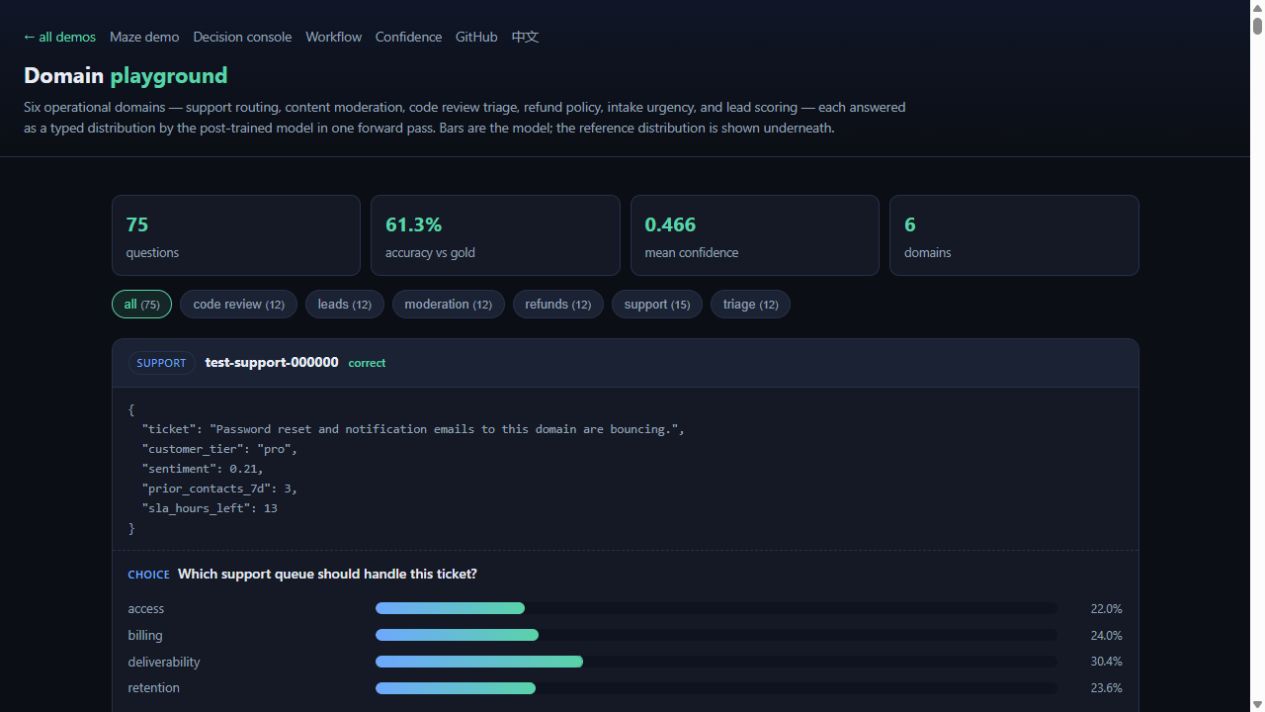
An independent family of LoRA adapters and scalar decision heads returns Choice, Noul and Score outputs over pinned Qwen backbones. The project publishes training data, evaluation records, a CPU classification workbench and interactive saved-decision replays.
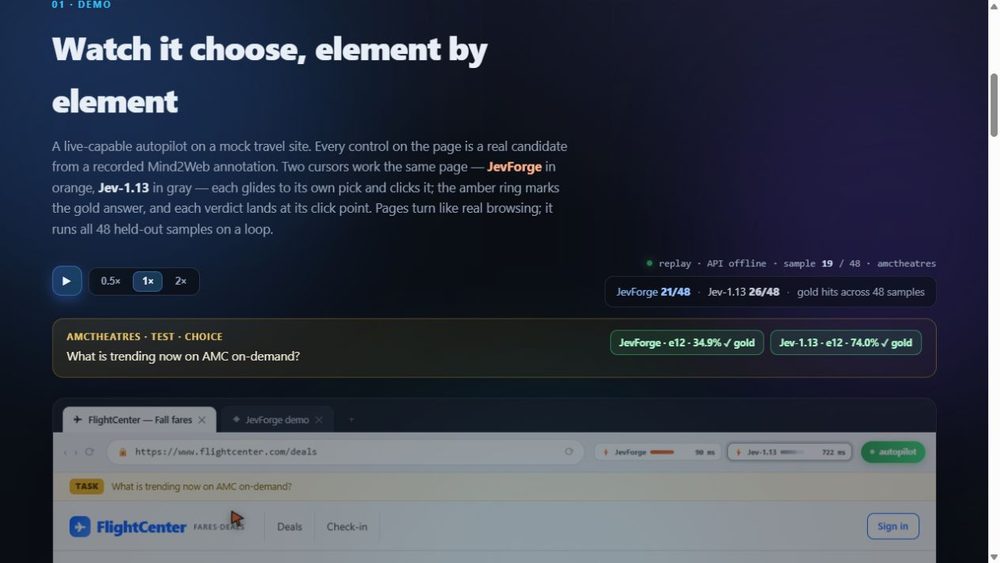
An end-to-end research toolkit builds decision records, trains and calibrates candidate scorers, and serves a Jev-compatible API. Its released Qwen3.5-0.8B model ranks supplied web actions, while the public demo presents recorded Mind2Web decisions.
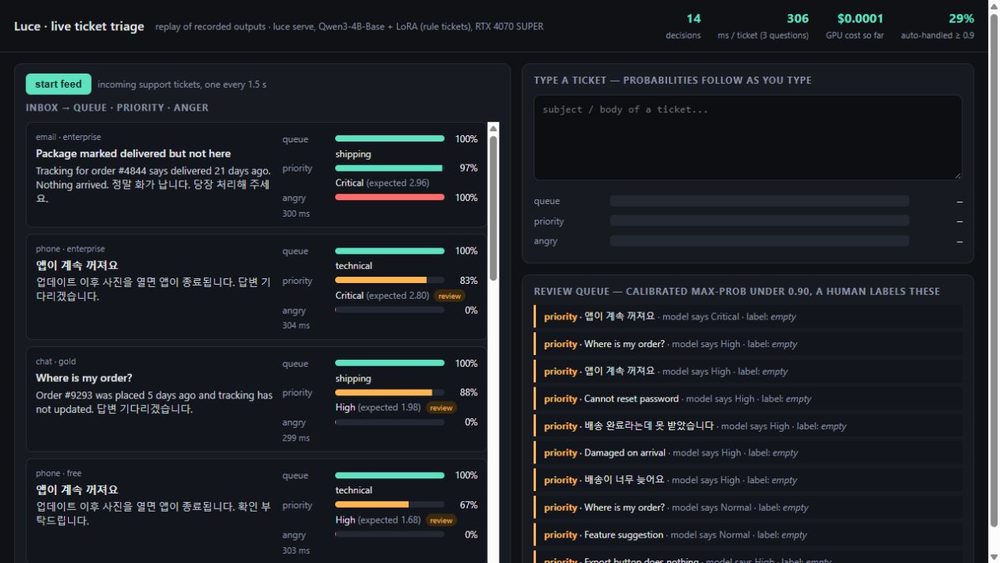
A task-specific pipeline generates or labels data with an LLM teacher, trains a LoRA and decision head, then evaluates and serves Choice, Score and Noul probabilities. A public support-triage replay shows saved model outputs and review routing.
A local MCP server gives coding agents Jev judgments for loop routing, patch review, evidence checks and candidate ranking. Its prepared-call router selects an exact host-supplied tool call while retaining the original arguments locally.
A Python routing engine combines inspectable YAML rules with Jev judgments to assign requests to agents or skills. Its Claude Code hooks can discover the installed roster and turn confidence bands into routing, suggestion or confirmation verdicts.
A Chrome side panel discovers WebMCP tools exposed by the current page and uses Jev to predict a tool and its arguments from the user's input. Questions are derived from the tool schema, including choices, booleans and spans of the user's own words.
A Playwright reporter asks Jev which discovered browser tests are relevant to a code change before browser execution. It combines changed paths and patches with test metadata and optionally test source.
A Python code-navigation library builds a structural index and composes small Jev judgments into best-first source searches. Its commands can trace known workflows or find matching functions while saving source provenance and partial results.
A CLI, MCP server and library combine ripgrep recall with Jev judgments over candidate files and passages. Results contain original source excerpts with paths, line numbers and explicit omitted ranges.
A Pi extension applies deterministic policies before asking Jev to judge uncertain bash, write and edit calls. It records semantic decisions and blocks calls when the default policy cannot reach a decision.
A Claude Code plugin sends instruction checks, context retention and subagent routing judgments to Jev. Context compaction retains selected original blocks instead of writing a new summary, with a Pi compaction adapter also included.
A self-hosted router asks Jev to assess fresh coding tasks and applies YAML policies to choose an upstream model and reasoning effort. Strict sessions retain their admitted model, provider and limits through later tool calls.
A Go controller uses Jev to select native macOS actions from Accessibility observations provided by a persistent Swift worker. Closed target tokens keep selected actions tied to the current app and window state.
An MCP server uses Jev to drive Chrome through observed page elements, either in an existing browser through an extension or in a separate profile. Tasks expose progress, questions and extracted results to the host agent.
A TypeScript browser SDK combines native Playwright actions with Jev decisions over observed elements. Its CLI, MCP server and library share the same execution and verification core.
An independent reranking benchmark paired with a live natural-language search over Y Combinator companies. The app uses Jev for query routing and reranking after keyword and embedding retrieval.
An independent Jev-style project that freezes a language-model backbone and trains a small decision head over cached candidate features. It publishes typed probability outputs, datasets and browser presentations of its benchmark and game policies.
A local daemon and CLI for downloading and running open decision models behind a TypeSafe-compatible API. It includes an MCP interface and model definitions for typed Choice, Score and Noul workflows.
An independent Jev-inspired model and serving project for Apple Silicon. Fine-tuned open backbones return Choice, Score and Noul probabilities through a Jev-shaped API, with calibration artifacts and worked use cases.
A browser and macOS computer-use harness that checks completion claims against observed state and gates irreversible actions with Jev. Its dual mode also delegates mechanical steps to Jev while a driver handles broader decisions.
A local TypeScript library and CLI where Jev chooses exploratory browser actions and assesses observed results. Playwright executes configured actions, exact assertions decide outcomes, and saved traces support replay.
A local MCP server for Windows that combines UI Automation actions with checkpointed web-research jobs. Jev selects from a bounded desktop action list and can rerank stored evidence or check a claim against an exact passage.
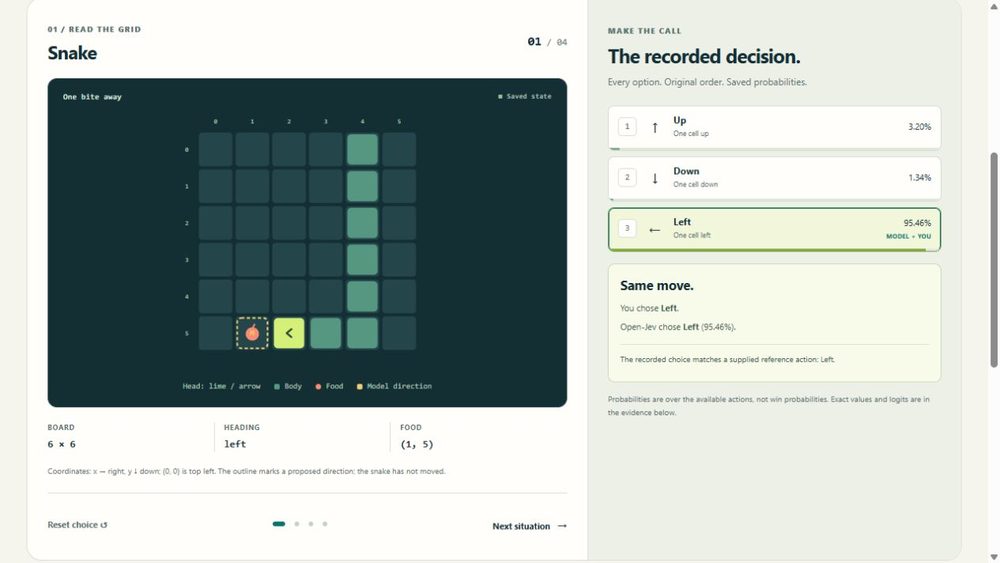
A TypeScript workspace containing Hundred, a town of 100 NPCs, and Jev Shogi, a human-versus-model board game. Each Jev request carries compact state and engine-legal next actions.
A React and Three.js arena shooter built around coffee deliveries and Jev-selected NPC tactics. Deterministic TypeScript owns the simulation, while recorded decisions can be replayed without model calls.
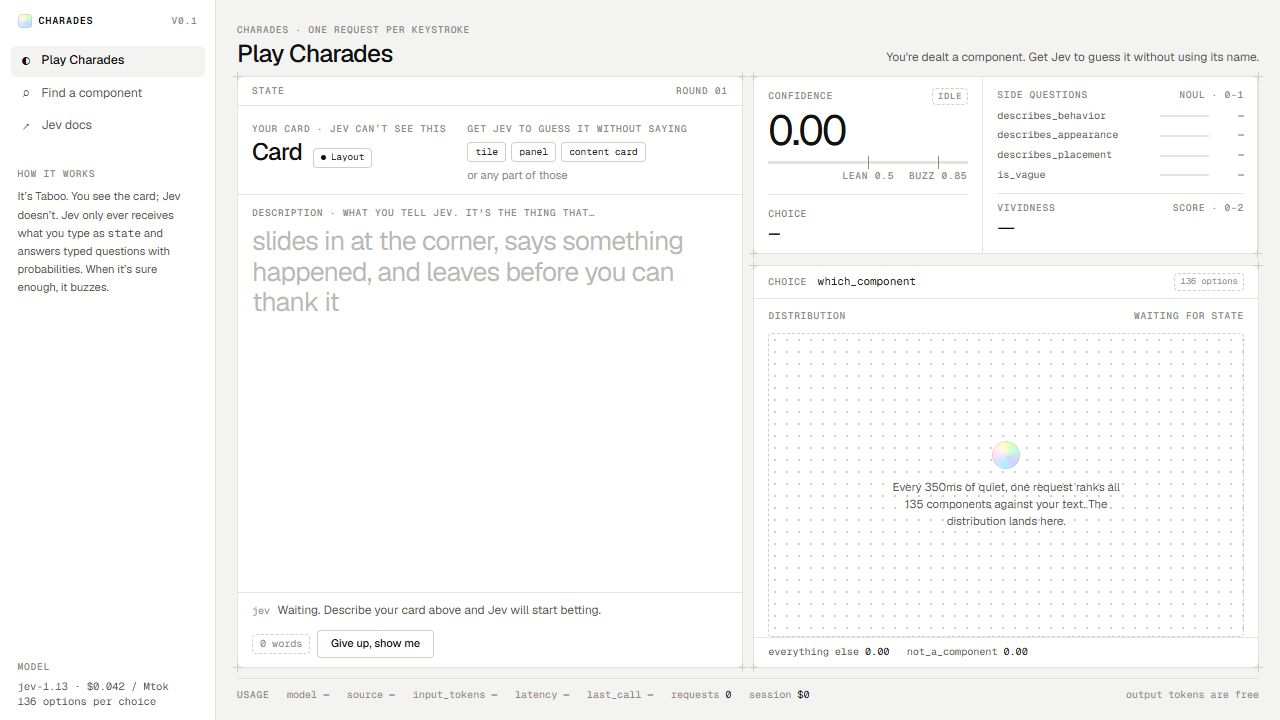
A Taboo-style game where a player describes a UI component without its forbidden words and Jev ranks the component library. A second mode finds a component from the job the player needs it to perform.
An experimental browser harness for the original Civilization II that asks Jev to choose empire, city, research, diplomacy and unit actions. It records player-visible observations and model probabilities in a spectator display.
A harness for the original StarCraft shareware campaign that gives Jev structured visible game state and executes its choices through keyboard and mouse inputs. The release includes a probability-overlay video and an inspectable run bundle.
A configurable LIBERO robot-control experiment that combines Jev decisions with reversible physics previews. An interactive replay follows intent, motion family and control choices alongside saved trajectories.
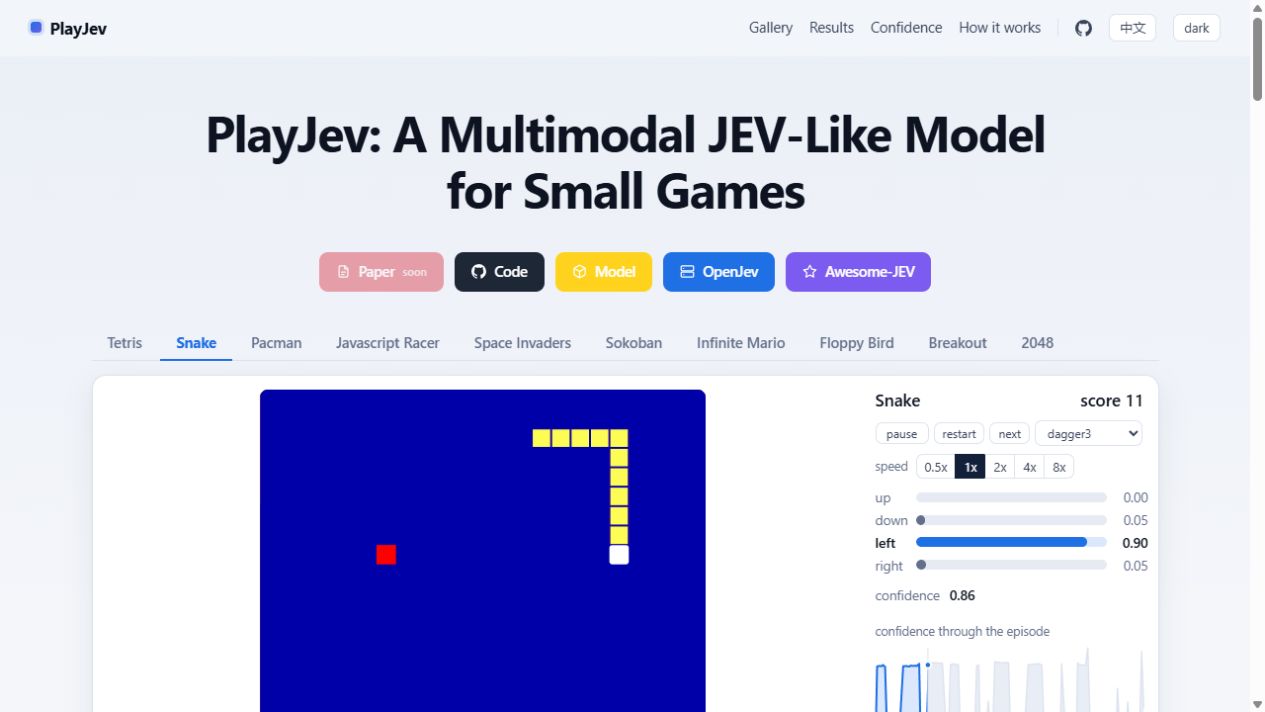
An independent Jev-like model fine-tuned from Qwen3.5-0.8B-Base to choose legal actions from raw game frames. The project publishes model weights, training records and a gallery of ten browser games.
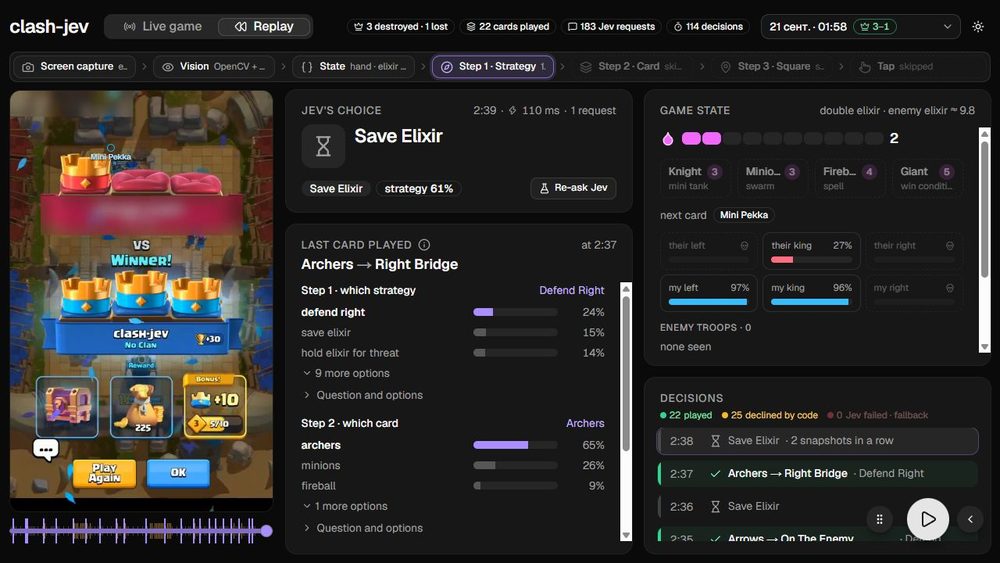
A Clash Royale experiment on an Android device that converts screen video into structured game state. Jev selects a strategy, card and placement, while the replay viewer exposes the questions and option probabilities.
A DeepSeek Harness plugin uses Jev for tool relevance, pre-execution call assessment, skill hints and model-route selection through a reusable decision core.